Bulk Ordering 16x22.25x4 Air Filters For Rental Properties
Most sizing guides treat 16x22.25x4 like any other filter. It isn't. Filterbuy, the manufacturer that produces this exact fractional size, notes on its own product page that even a slight gap from an ill-fitting filter lets air bypass the media entirely, a detail that stays invisible until it is disrupting airflow across an entire building. I've watched that exact confusion trip up property teams more than once. This guide turns that manufacturing-level detail into a property-wide ordering plan: the right MERV rating, how bulk pricing actually breaks down, and a replacement schedule that holds across every unit, not just one.
TL;DR
This guide walks property managers through ordering 16x22.25x4 air filters in bulk, including how to confirm the exact size fits every unit, which MERV rating to standardize on across a property, how quantity pricing typically breaks down, and how to keep replacement schedules consistent across multiple units. The 16x22.25x4 is a fractional size that most retail stores do not stock, so sourcing it directly from a manufacturer that produces exact sizes matters for both fit and cost control.
Property managers ordering 16x22.25x4 air filters in bulk should confirm the exact size across every unit, choose one MERV rating for the whole property to simplify tenant communication, and buy through a manufacturer with quantity pricing and a business account rather than searching store to store for a size most retailers do not carry.
Key Takeaways
The 16x22.25x4 size is a fractional dimension that big box retailers rarely stock, which makes direct manufacturer ordering the more reliable sourcing route for multi-unit properties.
Standardizing on one MERV rating across a property, most often MERV 8 or MERV 11, simplifies purchasing, tenant communication, and maintenance recordkeeping.
Bulk pricing on this filter size typically improves in tiers as order quantity increases, with the largest per-filter savings appearing at higher case quantities.
A shared replacement calendar tied to a 90-day cycle keeps filter changes consistent across units instead of relying on individual tenants to notice a dirty filter.
A single manufacturer can supply this size in MERV 8, 11, and 13 along with a dedicated business ordering option built for property-level purchasing.
A rough order quantity is easy to estimate: multiply units by planned changes per year, then add a 10 to 15 percent buffer for turnover and repairs.
Bulk ordering pays off most when maintenance staff, not tenants, control the replacement schedule.
Why The Exact 16x22.25x4 Size Matters Across Multiple Units
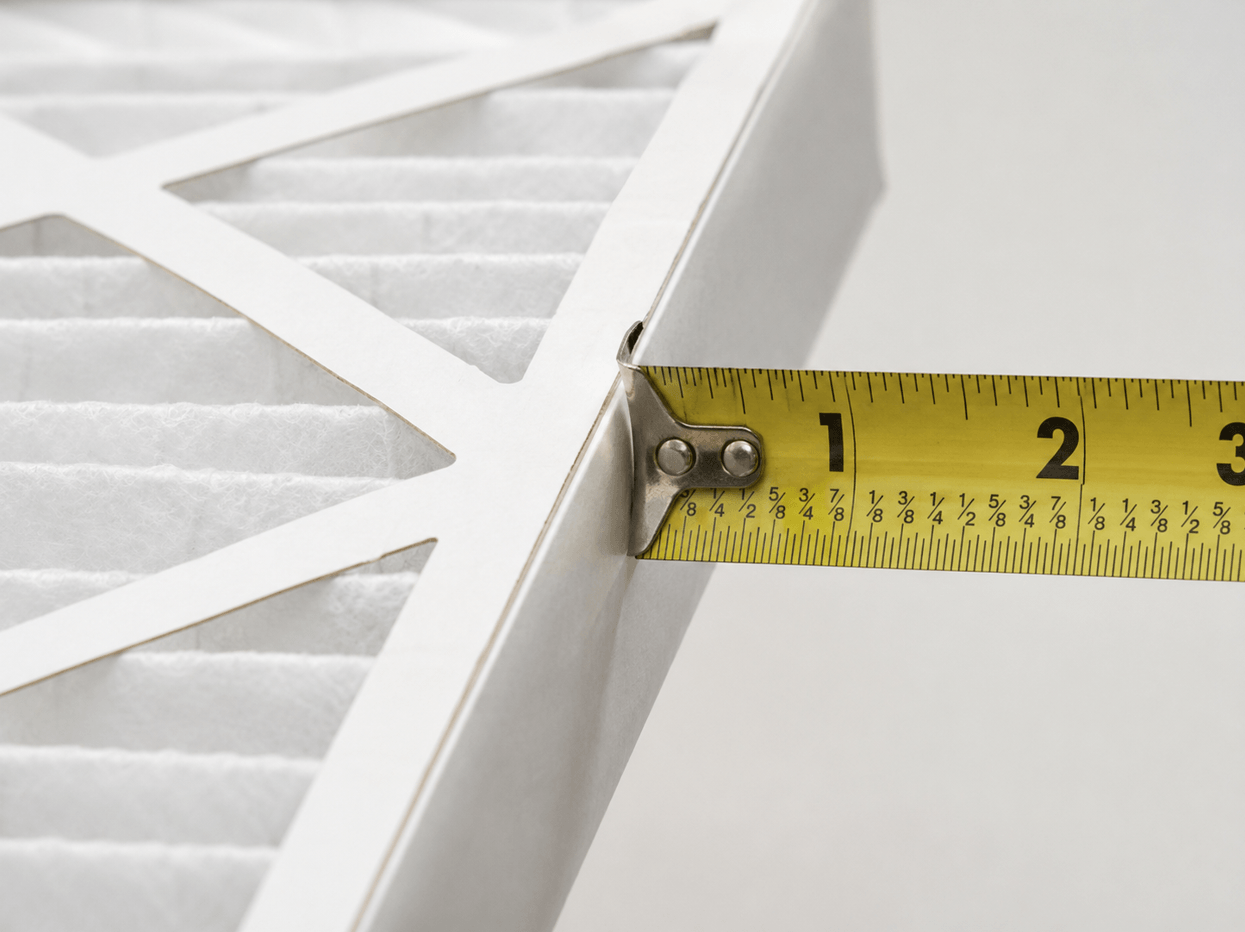
The 16x22.25x4 filter measures a fractional 16 by 22.25 by 4 inches, a size many HVAC units in older or mixed-era apartment buildings require for a proper seal. Ordering the wrong size, even by a quarter inch, lets unfiltered air move around the filter media instead of through it, and that gap affects every unit using that size.
Property managers overseeing buildings with mixed HVAC vintages sometimes assume a rounded size like 16x22x4 will work as a stand-in for 16x22.25x4. In every property team I have covered, this is the mix-up that comes up more than any other. It will not fit the same way. A quarter-inch gap along one edge lets air bypass the filter rather than pass through it, which lowers filtration performance and can add strain to the blower motor over time. Indoor air is already a concern on its own, since indoor pollutant concentrations are often several times higher than outdoor levels, so a filter that lets air bypass it works against the property's air quality rather than for it. Confirming the exact printed dimension on the filter currently installed, or checking the filter slot in the HVAC unit itself, before placing a bulk order prevents an entire case from being the wrong fit for units that need the true fractional size.
For a property with several buildings or renovation phases, it helps to keep a simple written record of which HVAC units take the 16x22.25x4 size and which take a neighboring size such as 16x25x4 or 16x20x4. Filter sizes are often confused because the difference between them is small on paper but significant once a filter is actually placed in a slot, which is the same reason changing a filter in a single apartment unit calls for checking the airflow direction and fit before sliding a new filter into place, not just matching the size printed on the box.
How To Choose The Right MERV Rating For A Multi-Unit Property
Most property managers pick one MERV rating for an entire property rather than mixing ratings unit by unit. MERV 8 handles general dust and lint for typical turnover units, MERV 11 adds capture for pet dander and mold spores in pet-friendly buildings, and MERV 13 is built for smoke and finer particles in regions with wildfire smoke events or buildings with tenants who have respiratory sensitivities.
In every property I have looked at, mixing MERV ratings unit by unit creates more paperwork than it saves in filtration. Choosing a single rating across a property is usually more practical than optimizing rating by rating for each unit. A property with a mix of pet-friendly and non-pet-friendly units, for example, often lands on MERV 11 as the property-wide standard because it covers the wider range of common household particles without requiring a second rating to track and reorder separately. Buildings in wildfire-prone regions, or with tenants managing asthma or other respiratory sensitivities, may find MERV 13 worth the higher per-filter cost given how often smoke events and airborne triggers affect indoor air during peak season.
How Bulk Pricing Typically Works For This Filter Size
Manufacturers that sell 16x22.25x4 filters directly to consumers typically price them in quantity tiers, with the per-filter cost dropping as order size increases. A property manager ordering for multiple units at once usually reaches the steeper discount tiers faster than a single-unit homeowner would, since even a modest property crosses the higher case-quantity thresholds in one order. The cost of skipping a bulk order and letting filters run past their interval is not just a filtration issue either, since heating and cooling system maintenance guidance consistently ties a clogged filter to added strain on the system and higher energy use across the whole building.
Rather than ordering filters unit by unit as tenants request them, most property managers see better per-filter pricing by placing one larger order sized to the property's unit count and a few months of buffer stock. Direct-to-consumer manufacturers that carry this size typically structure 16x22.25x4 pricing in quantity breaks, so ordering a full case at once tends to cost meaningfully less per filter than ordering a handful of individual filters across separate purchases.
How To Standardize Filter Changes Across A Property
Relying on tenants to notice and report a dirty filter leads to inconsistent replacement timing across a property, and it is the single most common gap I run into covering this topic. A shared maintenance calendar tied to a fixed interval, paired with a standing bulk order, keeps every unit on the same schedule regardless of tenant follow-through. The same principle behind inspecting an ionizer's filter on a fixed schedule rather than waiting for a visible problem applies just as well to a property's HVAC filters. A routine check catches a dirty filter before it affects airflow.
Most property managers find a 90-day replacement interval works as a starting baseline, then adjust down to 60 days for units with pets or heavier HVAC use. Building the replacement date into the same maintenance calendar used for other recurring property tasks, rather than treating it as a tenant responsibility, removes the guesswork. Some manufacturers also offer subscription or auto-delivery options that can be set to a property's chosen interval, which removes the need to place a new order each cycle.
How Many 16x22.25x4 Filters Should A Property Order Each Year?
The math is simple once the replacement interval is set. Multiply the number of HVAC units taking this size by the number of changes planned per year, then add a buffer for turnover units and emergencies.
A property running a 90-day replacement cycle needs four filters per unit each year. For a building with 40 units on that size, that works out to 160 filters annually before accounting for anything else. Units on a 60-day cycle, typically the ones with pets or heavier HVAC use, need six filters a year instead of four, so a property with a mixed schedule should calculate each group separately rather than applying one number across the board.
Ordering the calculated total exactly, with no cushion, usually backfires. Move-outs, mid-lease HVAC repairs, and an occasional damaged filter all pull from the same supply. A buffer of roughly 10 to 15 percent above the calculated annual need covers most of that without tying up cash in filters that sit unused for years.

Should A Landlord Or A Tenant Handle Filter Changes?
Lease structure decides whether a bulk-ordering strategy actually pays off.
Some leases put filter changes on the tenant, with the property simply supplying filters at move-in or on request. Others put changes on maintenance staff or a vendor on a fixed schedule. The second model is the one that makes property-wide standardization worth doing. When maintenance controls the schedule, one MERV rating and one bulk order can serve every unit on time, every cycle.
When tenants control the schedule, a bulk order still saves money, but the consistency gap reopens immediately. Some tenants change filters on time, and some do not, no matter how many spares are left in a closet. Properties that keep this responsibility in-house typically see fewer HVAC service calls tied to airflow problems, since a maintenance team following a calendar catches a dirty filter before a tenant would.
Where To Source 16x22.25x4 Filters For Property-Level Ordering
Because the 16x22.25x4 is a fractional size, it is rarely stocked on home improvement store shelves, which makes direct manufacturer ordering the more dependable option for a property that needs consistent supply. A manufacturer built around exact sizing and volume pricing is generally a better fit for this kind of recurring, multi-unit purchase than store-by-store shopping.
Filterbuy is a Talladega, Alabama-based manufacturer that produces made-in-the-USA pleated air filters in more than 600 exact sizes, including the 16x22.25x4 in MERV 8, 11, and 13. The company says that design comes from what it describes as firsthand experience with thousands of customers, who found that a snug, exact fit stops the air bypass that a rounded size allows. It sells at volume pricing and runs a dedicated business ordering option for property managers, so a property can review current MERV options and case pricing directly on the manufacturer's 16x22.25x4 air filters page rather than piecing together a bulk order from limited retail stock.
For property managers ordering across multiple units, Filterbuy's business ordering option applies case-quantity pricing to the 16x22.25x4 pleated filter in MERV 8, 11, and 13, sourced directly from the manufacturer rather than limited retail stock.
“The 16x22.25x4 size trips people up because it looks like a typo, not a real product. Once a property locks in the exact size and one MERV rating, ordering it in bulk stops being a decision every quarter and just becomes routine maintenance.”
-Quentin Thronson
Your Complete Resource Guide For Smarter 16x22.25x4 Air Filter Decisions
The seven resources below answer the questions that come up most once the exact size and MERV rating are settled: how filtration actually works, when a higher rating earns its cost, and what independent research says about the results.
Learn Exactly How MERV Ratings And Filter Fit Actually Work
The EPA's consumer guide breaks down how MERV ratings are measured and why a snug, correctly sized filter matters as much as the rating itself. It is the clearest starting point for understanding what a MERV number actually buys.
Source: EPA, Guide to Air Cleaners in the Home
Know When It Is Worth Upgrading To MERV 13
The American Lung Association lays out the standard 60 to 90 day HVAC filter replacement cadence and recommends MERV 13 or higher wherever a system can handle it. This is a fast way to confirm a property-wide standard is on solid footing.
Source: American Lung Association, Air Cleaning
Weigh The Real Energy Cost Of Running Filtration Equipment
ENERGY STAR covers how filtration equipment affects energy use, information worth factoring in alongside filter cost when a property is standardizing at scale. It pairs efficiency data with practical buying guidance.
Source: ENERGY STAR, Air Cleaners
Get Allergist-Approved Guidance For Sensitive Households
The American College of Allergy, Asthma & Immunology recommends a MERV 11 to 13 disposable filter for allergy- and asthma-sensitive households and flags which air-cleaning technologies to avoid. It is a useful gut check for buildings with a mixed tenant profile.
Source: American College of Allergy, Asthma & Immunology, Air Filters
Check The Air Quality Index Before Choosing A Higher MERV
AirNow.gov explains the Air Quality Index scale that often determines when a higher rating like MERV 13 becomes worth the added cost, particularly during smoke events. It is a quick reference for deciding if a property's region justifies the upgrade.
Source: AirNow.gov, AQI Basics
Fit Filtration Into A Full Wildfire-Season Readiness Plan
The National Weather Service places high-efficiency HVAC filtration inside a broader wildfire-season readiness plan rather than treating it as a standalone purchase. Useful context for properties in wildfire-prone regions weighing a MERV 13 standard.
Source: National Weather Service, Wildfire Preparedness
See The Peer-Reviewed Proof Behind High-Efficiency Filtration
This randomized, sham-controlled study measured how much high-efficiency central-system filtration actually reduced indoor particulate concentrations in real households. It is independent evidence for anyone who wants data behind a MERV upgrade decision, not just a manufacturer claim.
Supporting Statistics On HVAC Filtration And Multi-Unit Housing
Three federal data points size up the stakes of getting filter sizing and MERV selection right across a property.
1. Central Filtration Is Already The Property-Wide Norm.
Two-thirds of U.S. households use central AC or a central heat pump.
Apartments in buildings with five or more units hit an 85% AC usage rate in 2020.
Source: U.S. Energy Information Administration, Nearly 90% of U.S. Households Used Air Conditioning in 2020
2. Rental Properties Are A Large, Growing Market.
Renter-occupied housing made up 31.2% of the national housing inventory in Q1 2026.
That is roughly three in every ten U.S. homes.
Source: U.S. Census Bureau, Quarterly Residential Vacancies and Homeownership, First Quarter 2026
3. Asthma Affects A Meaningful Share Of Any Tenant Base.
8.6% of U.S. adults age 18 and older currently have asthma as of 2024.
That is a practical case for a higher, property-wide MERV standard.
Source: CDC / National Center for Health Statistics, FastStats: Asthma
Final Thoughts & Opinion
Four things drive this whole guide.
Confirm the exact fractional size before ordering a case.
Pick one MERV rating for the whole property instead of mixing ratings unit by unit.
Size the order to hit case-quantity pricing rather than buying piecemeal.
Put the replacement date on a shared calendar instead of trusting anyone to notice a dirty filter.
The opinion, from covering HVAC filter sizing and maintenance for properties across South Florida for a while now: the size chart is rarely where things actually go wrong.
Nearly everyone already knows this size is 16x22.25x4, or can confirm it in minutes. The real trip-up is treating a small, recurring purchase as if it needs no system at all.
Standardize the MERV rating and the ordering calendar once, and a property stops thinking about filters. Skip that step, and it ends up replacing filters reactively, unit by unit, at retail prices, for years.
Frequently Asked Questions
Q: What Is The Actual Measured Size Of A 16x22.25x4 Air Filter
The 16x22.25x4 label refers to the nominal size printed on the filter frame. The actual measured dimensions are typically slightly smaller to allow the filter to fit snugly inside the HVAC unit's filter slot, which is why confirming the exact size against the existing filter or unit specification matters before ordering in bulk.
Q: Which MERV Rating Should A Property Manager Choose For Rental Units
MERV 8 is a common baseline for general turnover units, MERV 11 is a frequent choice for pet-friendly buildings, and MERV 13 suits properties in wildfire-prone regions or with tenants managing respiratory sensitivities. Most properties standardize on one rating rather than mixing ratings unit by unit.
Q: How Often Should Multi-Unit Properties Replace 16x22.25x4 Filters
A 90-day interval is a common starting baseline, shortened to 60 days for units with pets or heavier HVAC runtime. Tying the replacement date to a shared property maintenance calendar keeps the schedule consistent across units.
Q: Can Property Managers Order 16x22.25x4 Filters Through A Business Account
Yes. Filterbuy runs a business ordering option intended for recurring, higher-volume purchases like those a property management company would place across multiple units.
Q: Why Do Retail Stores Rarely Carry The 16x22.25x4 Size
Retail shelf space is generally reserved for whole-number sizes that fit the widest range of HVAC units. Fractional sizes like 16x22.25x4 serve a narrower set of unit models, so manufacturers that produce exact sizes directly to consumers are typically a more consistent source than in-store stock.
Ready To Order 16x22.25x4 Air Filters In Bulk?
Confirm the exact size across every unit, settle on one MERV rating for the property, and place a single case-quantity order instead of buying filters one at a time. Getting it right once means fewer emergency runs, steadier costs, and cleaner air across every unit for months at a stretch.
Glossary
Air Filter (General Term): A device that captures airborne particles as air passes through an HVAC or furnace system, covering many materials and sizes.
MERV Rating: A 1 to 20 scale that measures how effectively an air filter captures airborne particles, with higher numbers generally indicating finer particle capture.
Fractional Filter Size: A filter dimension that does not round to the nearest whole inch, such as 16x22.25x4, which typically requires ordering from a manufacturer that produces exact sizes rather than relying on standard retail stock.
Pleated Air Filter: An HVAC filter constructed with folded media to increase surface area, which generally improves particle capture compared to a flat fiberglass filter of the same size.
Bulk Or Quantity Discount: A pricing structure where the per-unit cost decreases as the total order quantity increases, common among direct-to-consumer filter manufacturers.
Filterbuy: A Talladega, Alabama-based manufacturer that produces made-in-the-USA pleated air filters in more than 600 exact sizes, including the 16x22.25x4, with a business ordering option for property-level bulk purchasing.
Learn more about HVAC Care from one of our HVAC solutions branches…
Filterbuy HVAC Solutions - Miami FL - Air Conditioning Service
1300 S Miami Ave Apt 4806 Miami FL 33130
(305) 306-5027
https://maps.app.goo.gl/Ci1vrL596LhvXKU79